

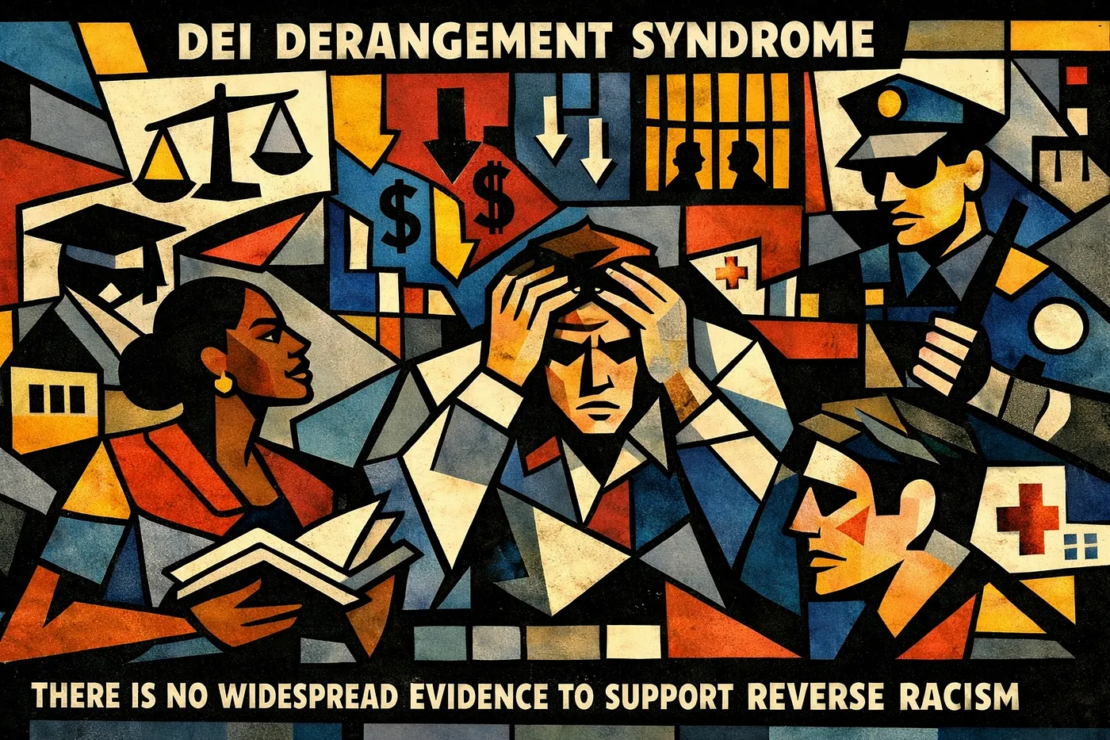
There Is No Widespread Evidence to Support Reverse Racism
Six days into Black History Month, Donald Trump’s blatantly racist Truth Social post depicting Barack and Michelle Obama as apes should be enough to debunk the concept of reverse racism. But I’m old enough — and smart enough — to know it won’t. I also know there are no apes in The Lion King, the content upon which the President and the White House claim the post is based.
Talk about things that make you go hmm…
Trump’s history of racism is not surprising, nor is it particularly shocking. He’s shown who he is all along — even if some prominent Republicans are only now signaling their suspicion that Trump and his administration have not only finally crossed a line, but might just be the new Klan reimagined.
Of course, he builds his racist platform on the belief held by many white Americans that they — white people — are under siege by Black and brown people who are stealing their jobs, their status, and their way of life.
But even a broken clock is right twice a day. So I dug deep to find out whether there is any truth — beyond the odd, very odd anecdote — that reverse racism exists.
I’ve studied the dynamics between race, culture, and power in the United States for decades. I remember returning home from grad school and finding myself in one of those fun political holiday arguments around the family dining table. At one point, my brother said, “It must be exhausting thinking about being Black all the time.”
He was right. It is exhausting. I’d like to stop thinking about it, but white people are determined to force the issue every single damn day. Someone has to do this work.
So, knowing that Donald Trump’s rise to power is fueled by his racism and his willingness to fire it up in other white folks, I thought I’d ask the question:
Is reverse racism real?
I won’t sugarcoat this.
No. And pretending otherwise is a luxury only power can afford.
A curious thing keeps happening in America.
White people keep claiming they’re being racially harmed — not by redlining, not by police violence, not by voter suppression, not by medical neglect — but by being disagreed with, being asked to share, or no longer being automatically centered in American culture.
This is what is usually called “reverse racism.”
It sounds serious.
It feels aggrieved.
It just isn’t real.
So let’s ask the only question that matters:
Is there evidence that being white, as a group-level trait, produces measurable, systemic harm to white people?
Not vibes.
Not anecdotes.
Not a bad day on Twitter.
Evidence.
First, Let’s Define Racism Like an Adult
In social science, law, economics, and public health, racism is not “someone hurt my feelings.”
Racism is systemic. It shows up across institutions:
- employment
- housing
- education
- healthcare
- criminal justice
- wealth accumulation
- political power
Racism leaves receipts. So if “reverse racism” were real, we would see consistent, population-level harm attached to whiteness itself.
We don’t.
Follow the Numbers (They’re Not Subtle)
Across every major metric in the United States, white Americans — as a group — outperform every other racial group:
- higher median household wealth
- higher homeownership rates
- lower unemployment
- higher wages at the same education level
- lower poverty rates
- better health outcomes
- longer life expectancy
That doesn’t mean every white person is thriving. It means whiteness is not the cause of harm. If being white were a liability, the data would show it.
It doesn’t.
I’m a data scientist, and I can tell you plainly: the math behind reverse racism does not add up.
Employment: Where the Myth Should Have Died
Let’s talk for a minute about résumés.
For decades, researchers have sent identical résumés to employers with one difference: the name at the top.
The result, over and over:
- “white-sounding” names get more callbacks
- “Black- and Latino-sounding” names get fewer
- same qualifications
- same experience
- same schools
There is no study showing that white applicants are penalized for being white.
None.
If reverse racism existed in hiring, this is where it would show up.
It does not.
Education: The Loudest Lie, the Weakest Evidence
This is where the grievance industrial complex really goes to work.
You’ve heard it:
“White kids are being pushed out of schools.”
Reality check:
- legacy admissions overwhelmingly benefit white applicants
- donor preferences overwhelmingly benefit white applicants
- test prep, school funding, and zip code advantages skew white
Even under affirmative action, the largest beneficiaries have historically been white women. White men remain overrepresented at elite institutions relative to population share.
There is no credible dataset showing white students being systemically excluded because they are white.
What has changed is that the line is no longer reserved for white people.
That’s not oppression.
That’s access expansion.
Criminal Justice: The Easiest Disproof
If racism harmed white people as whites, we would see it here.
We don’t.
- white defendants receive shorter sentences for the same crimes
- white suspects are less likely to be stopped, searched, arrested, or killed by police
- white people are less likely to be wrongfully convicted
- white neighborhoods are less heavily policed
There is no evidence that whiteness functions as a criminal liability.
None.
Health Outcomes: Where Racism Always Shows Up
Structural racism leaves fingerprints on bodies.
Maternal mortality.
Chronic illness.
Environmental exposure.
Life expectancy.
White Americans fare better than Black, Indigenous, and many Latino populations across nearly every race-linked health outcome.
There is no population-level health penalty for being white.
So What Are People Actually Experiencing?
Three things — none of them racism.
1. Loss of Automatic Advantage and Authority
When systems stop tilting so steeply in your favor, it feels like punishment.
It isn’t.
It’s normalization.
2. Interpersonal Discomfort
Being challenged, criticized, or excluded socially is not racism.
Racism shows up in foreclosure rates.
Discomfort shows up in podcasts.
3. Zero-Sum Panic
As society diversifies, some white Americans confuse:
- inclusion of others
with
- exclusion of themselves
Equality feels threatening when you’re used to dominance.
The Truth No One Wants to Say Out Loud
“Reverse racism” is not an analytical concept.
It’s a defensive posture.
It exists to:
- shut down accountability
- reframe equality as persecution
- protect hierarchy without naming it
If racism against white people were real in a structural sense, it would show up where racism always does:
in outcomes.
It doesn’t.
The Bottom Line (And Yes, This Is the Point)
There is no empirical evidence — none — that being white produces measurable, systemic harm to white people.
There is overwhelming evidence that racism harms non-white groups in durable, structural, life-altering ways.
Pretending otherwise is not just wrong. It’s a luxury — one gifted by power, not pain.
And luxury grievances don’t deserve equal billing with lived inequality.
They deserve what the data gives them: